CONTEXT
Mobile App · Internal Tools · AI Integration
ROLE
Lead designer
Redesigned a safety-critical reporting platform into a scalable interaction framework that supported mobile work, multiple frontline roles, and later AI-assisted workflows.
Over 6 years, I owned this product from initial design through AI integration.
+102% report submissions in the first week
Scaled across multiple frontline employee groups
Evolved into United's first AI-assisted reporting workflow
Informs United's company-wide safety reporting initiative
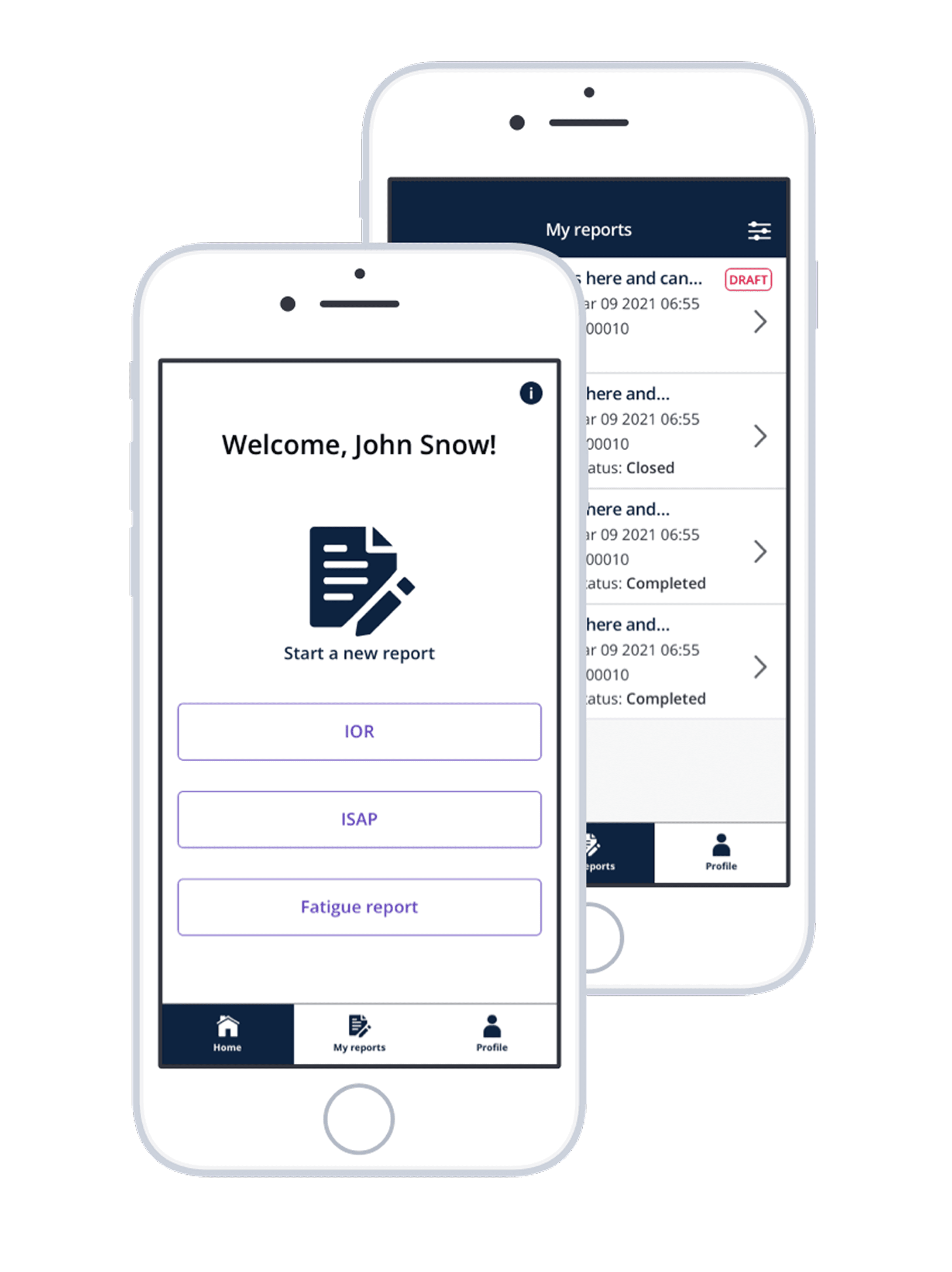
THE CONTEXT
Safety reporting at an airline is a core operational system used by 90,000 employees to protect passengers and each other across every flight.
The existing system hadn’t evolved with frontline work. It was built for desktop users, while the people doing the work were constantly on the move.
More than 70% of the workforce was mobile, creating friction for time-constrained employees who had 48 hours to submit their reports after incidents.
SINGLE SCROLLING REPORT

UNDERSTANDING FRONTLINE WORKFLOWS
Initial concepts relied on employees selecting flights from their schedules. However, research revealed that gate agents and ramp technicians are frequently reassigned to flights at the last minute, making scheduled workflows unreliable in real operational contexts. I had to design a way for employees to manually add flights.

THE PIVOT
Midway through the project, United shifted priorities. COVID introduced new passenger compliance reporting needs, and flight attendants became the first launch audience.
Rather than restart, I adapted the emerging interaction framework to support a different workforce.
The reporting model itself was largely fixed. The opportunity wasn't to redesign it, but to create an interaction framework that could scale within those constraints.

Taxonomy mapping from Miro, used to align the reporting model across domains.
I formalized a reporting taxonomy across flight, station, incident, conditions, and narrative domains, allowing the same reporting model to support different frontline workforces.
INTERACTION PATTERNS
01
PROGRESS PATTERN
Standard progress trackers consumed valuable vertical space during multi-step reporting workflows.
I replaced persistent navigation with a lightweight transition pattern that preserved orientation while keeping the reporting flow focused.
Later adopted into United's Employee UX mobile design system.

Research artifact showing the adopted progress pattern.

02
PROGRESSIVE DISCLOSURE
A single reporting framework had to support diverse incident types without overwhelming employees.
I surfaced conditional questions only when relevant, reducing cognitive load while keeping the reporting experience flexible.
One framework could now support diverse incident types without fragmenting into separate workflows.
03
REVIEW STEP
Employees needed confidence before submitting their reports.
I introduced an editable review step that summarized the report before submission, allowing employees to validate and refine their responses without revisiting multiple screens.
Validation became an integrated part of
the reporting workflow.


04
VOICE INPUT
Flight attendants often needed to document incidents while in transit or actively assisting passengers.
I introduced native voice-to-text so they could capture incidents in the moment instead of waiting until they had time to type.
Reporting no longer required stopping work to document it.
5 years later, the framework evolved.
The reporting framework remained in active use and later became the foundation for United's first AI-assisted reporting experience. MSA was the first reporting workflow to integrate with a voice AI platform, transforming dictated narratives into structured report fields.
RESPONSIBLE AI INTEGRATION
Designing AI transparency without disrupting workflow
United’s Responsible AI team required two conditions before approval: a persistent transparency disclosure and a user feedback mechanism. This conflicted with product goals around minimizing friction in the reporting flow.
Users needed to understand when AI was involved without slowing down reporting.
I placed the disclosure beneath the "Tap to speak" button, where it stayed visible but collapsible, keeping transparency available without interrupting the reporting flow.
Inline messaging helped identify when content had been generated using AI.


Users needed feedback to happen naturally at the end of the reporting experience.
I embedded the feedback mechanism directly into the review step, where employees were already validating their report.
Governance became part of the reporting workflow instead of an extra step.
This approach balanced Responsible AI requirements with product constraints while preserving a low-friction reporting experience.
IMPACT
The framework originally built for MSA became the foundation for United's company-wide safety reporting initiative.
What began as a reporting experience for airport operations evolved into the interaction framework now informing United's broader effort to modernize safety reporting across frontline workforces.
102% increase in report submissions during the first week
Reporting expanded from airport operations to additional frontline employee groups
Informed operational improvements, including infrastructure updates at DIA gates
The framework continued to evolve beyond the original release
Became the foundation for United's first AI-assisted reporting experience
Introduced interaction patterns later adopted into United's Employee UX mobile design system
Continues to inform United's company-wide safety reporting initiative